
A Practical Guide for Busy Parents to Local Kids Programs, Classes, and Community Activities

Instead of piecing together flyers, Facebook posts, and separate registration forms, you can map your local kids’ community in one clear view and choose with confidence. Community programs for kids do more than fill empty hours. They shape friendships, build skills, and give parents a support network when life is already packed.
This guide walks through the full landscape of local options, how to compare them quickly, where to find free and low cost choices, and how to turn scattered listings into a simple plan your whole family can actually follow.

Why local community programs matter for modern families
Local programs for children connect your family to the neighborhood around you. Kids meet classmates they might not otherwise talk to, discover trusted adults beyond school, and start to feel like they belong in the places they live, learn, and play. That sense of belonging often matters as much as the specific skill they are practicing.
For parents, community-based options reduce friction. Shorter drives, familiar locations, and predictable schedules add up to fewer last-minute scrambles. When programs are close to home or school, coordinating pickups, carpools, and shared responsibilities with another caregiver becomes far more realistic.
The main types of local kids programs you can tap into
Across most towns and cities, kids activities in your community fall into a few main groups. Understanding how each group is organized helps you know where to look and what to expect.
-
Community centers and parks & recreation departments: Often run by a city or town, these offer group classes, seasonal leagues, and after school community programs in shared spaces like gyms, pools, and multipurpose rooms.
-
Libraries and cultural institutions: Public libraries and museums typically run recurring clubs, story hours, and special events that support reading, curiosity, and creativity.
-
Nonprofits and youth organizations: These include mentoring programs, youth clubs, faith-based groups, and neighborhood nonprofits that focus on social connection, leadership, and access.
-
Schools and school-linked programs: Many districts partner with external providers or run their own enrichment activities on campus right before or after the school day.
-
Private studios and specialty providers: These cover focused offerings like music schools, coding labs, dance studios, language programs, and tutoring centers.
When you search on BeAKid, you can filter across these categories in one place instead of running separate searches on each institution’s website, which immediately saves time and reduces the risk of missing a great fit.
Filter across these categories in one place, BeAKid
Community center programs vs private lessons for kids
Many parents wonder how community center programs for kids compare with small-group or one-on-one private lessons. The formats serve slightly different goals and budgets, and seeing them side by side can clarify your choice.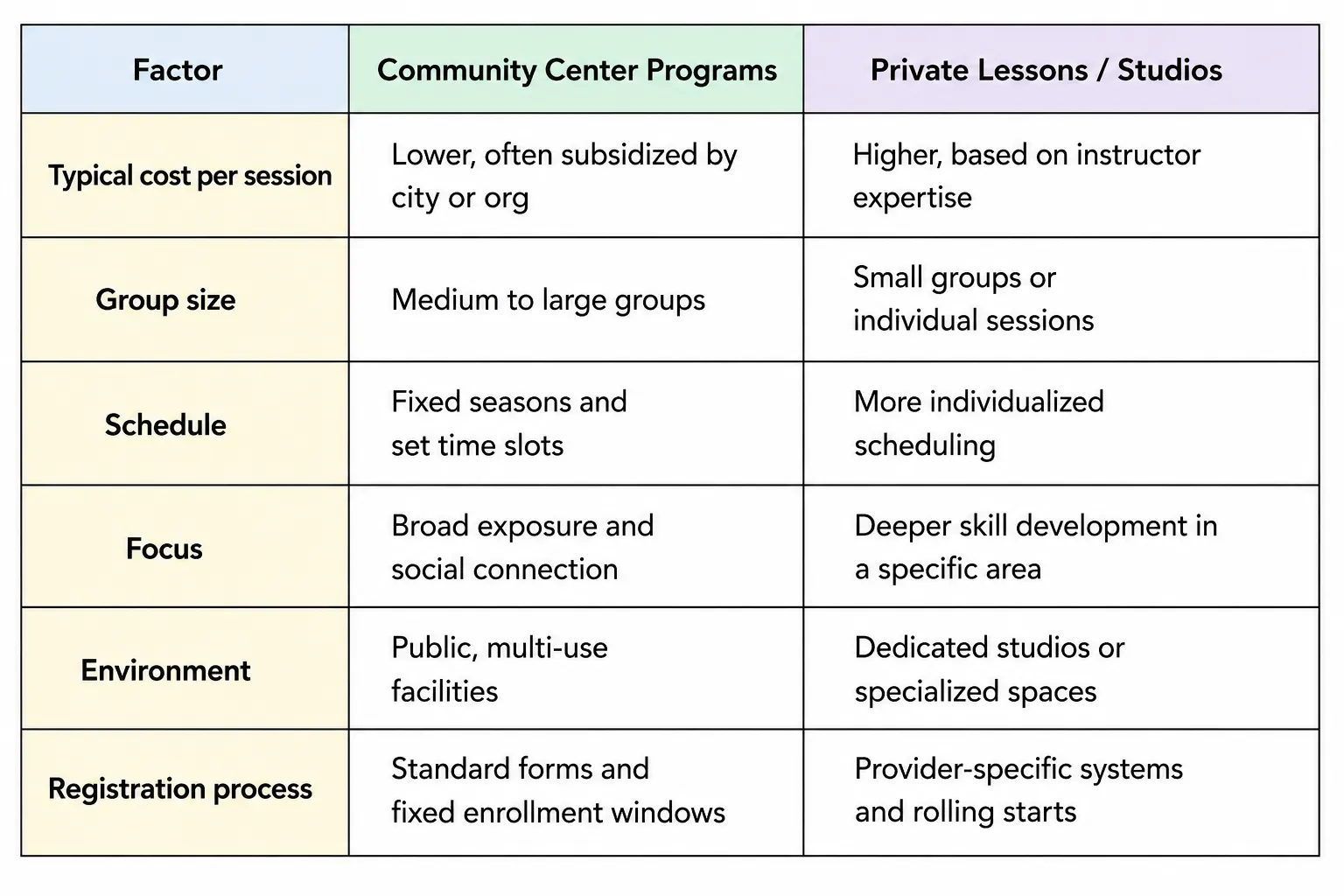 Community center options can be a strong fit when you want affordability, variety, and built-in social opportunities. Private lessons tend to work best when your child already shows strong interest in a particular activity and you want more focused, personalized instruction.
On BeAKid, you can see both types of programs on the same screen with clear pricing, dates, and age ranges so you are not trying to compare a city PDF against a private studio website in separate tabs.
Search BeAKid for community center and private providers
Where to find free or low cost activities in your community
If you are looking for how to find free or low-cost kids activities, start with places that are already funded to serve the whole community. Many families are surprised by how much is available when they know where to look.
Helpful starting points include:
- Public libraries: that host recurring programs and special events at no cost.
- City recreation departments: that offer sliding-scale fees or resident discounts.
- Nonprofits and youth organizations: that subsidize participation or provide scholarships.
- Community festivals, parades, and seasonal events: that include kids’ zones and workshops.
Online, it can be hard to chase down all of these options because information is scattered across city pages, flyers, and social media posts. On BeAKid, you can apply filters that highlight free programs, trial classes, and low cost options in a single search, which keeps your budget visible right alongside schedule and location.
Search BeAKid or free / low-cost activities
Spotlight on sports leagues, art classes, and library programs
Community sports leagues for kids help channel energy into structure. They usually emphasize teamwork, basic rules, and shared goals more than individual performance. This can be especially helpful if your child needs a predictable routine with clear expectations, or if you want them to build friendships through regular practices and games.
Community art classes for creative children support experimentation and self-expression. These classes often rotate through different mediums such as drawing, painting, or simple sculpture. The focus is usually on trying ideas, not on perfect technique, which can boost confidence and curiosity.
When it comes to what kinds of programs local libraries offer for kids, the range is often wider than storytime alone. Many libraries now include early literacy sessions, homework clubs, STEM workshops, reading challenges, and holiday events, all designed to make reading and learning feel social and fun.
If you are unsure where to start, you can search by theme on BeAKid, then quickly scan which sports, arts, and library-connected options match your child’s age and your available days.

Turning scattered options into a single family plan
Even when you know about great kids activities at your community center, local studios, and libraries, fitting them into a real schedule is another challenge. A simple sequence can turn a long list into a realistic plan.
- Start with fixed anchors: add school hours, your work hours, and any immovable commitments to a weekly grid.
- Choose one primary time block per child: decide on the one or two weekday blocks you are open to activities for each child, plus any weekend block you want to reserve.
- Layer potential programs into the grid: place each interesting program into the time slots, marking ones that overlap or require rushed travel.
- Narrow to the best fit per slot: for each time block, choose the program that best matches your child’s interest, your budget, and your transportation reality.
On BeAKid, you can short-cut this process by favoriting programs that match your preferred days and seeing them organized together, which makes it easier to spot conflicts before you enroll.
Favoriting programs that match your preferred days on BeAKid
How BeAKid compares to other ways of finding kids’ activities
Many parents start with Google or community social network groups. Each approach has strengths, but they often leave gaps in either discovery or day-to-day logistics.
Helpful for broad ideas and word-of-mouth tips, but information is unstructured. Program details, dates, and registration links may be out of date or hard to verify quickly.
BeAKid is designed to bring discovery and operations together. The same place you use to see program options, reviews, and costs is the place you use to enroll, pay, and keep track of schedules. That combination reduces the need for extra spreadsheets, email threads, or separate notes about who is picking up on which day.
See program options, reviews, and costs on BeAKid
How BeAKid connects your family to your local kids’ community
BeAKid serves as a live map of community programs for kids in your area. Instead of looking at each provider or institution separately, you see a unified view of what is available for your children’s ages and interests, with transparent information presented in a consistent format.
Because providers manage their own listings within the platform, details such as age ranges, session dates, refund policies, and communication methods are easier to compare at a glance. That clarity supports faster, more confident decisions without long email chains.
BeAKid also supports families when more than one caregiver is involved. Once a program is selected, both parents or caregivers can share visibility into activity details. That shared view helps reduce misunderstandings about times, locations, and expectations, particularly around school breaks or custody changes.
From browsing local camps and youth programs to confirming a spot and saving it to your account, you stay inside a single system that keeps kids at the center and minimizes extra steps.
Search BeAKid for local camps and youth programs
FAQ
How do I find community programs for kids near me?
You can start by checking your city recreation department, local library, and school district websites, then search on a dedicated platform like BeAKid that organizes listings by age, location, and interest so you can compare everything in one place.
What kids activities are usually offered at my community center?
Kids activities at your community center often include sports clinics, swim lessons, general fitness classes, arts and crafts sessions, and school break camps, all scheduled in seasonal sessions with clear start and end dates.
How can I quickly compare different after school community programs?
Create a short list of options, then compare them on four points only: total cost, weekly time commitment, distance from school or home, and how clearly each program describes expectations around communication and late pickups.
Are community sports leagues for kids good enough compared to private clubs?
Community leagues generally focus on participation, basic skills, and teamwork, which is usually more than enough for most kids. Private clubs may offer more intensive training, but they also require greater time and financial investment.
What is the fastest way to turn a long list of programs into a real schedule?
Limit each child to one or two weekday time blocks, add only programs that fit those windows, then choose the single best option per block. Using a tool like BeAKid to save and view those programs together helps you spot conflicts before enrolling.
Finding the right mix of local programs does not have to take your entire weekend. Once you see your library, community center, nonprofits, schools, and private providers as parts of the same ecosystem, choices get simpler. You can focus on what fits your child, your budget, and your real schedule instead of chasing scattered links.
If you are ready to see everything in one view, explore community programs for kids in your neighborhood on BeAKid, save your favorites, and build a clear activity plan that works for your whole family.